
Do I need an ADS-B receiver to track planes?
No. Thousands of receivers already share what they hear with tracking networks, and sites, apps and FlightAbove displays read that picture over the internet. A receiver of your own is optional.
Receivers and antennas
Not to see the planes over your house. Thousands of people already run receivers and share what they hear, so the aircraft near you are almost certainly being picked up. A tracking site, an app or a FlightAbove display reads that shared picture over the internet.
Building your own receiver is a satisfying project, and it adds coverage for everyone. It is worth doing if you enjoy the tinkering, live somewhere with poor coverage, or want to feed a network. It is not a requirement.
The shared picture
Most aircraft broadcast their position, height, speed and identity on 1090 MHz, about twice a second. Anyone with a cheap radio and an antenna can receive it. Volunteers, airports and companies run thousands of these receivers and send what they hear to tracking networks, which combine it into one live picture.
Community networks such as adsb.fi and adsb.lol publish that picture openly, and FlightAbove reads from them. Commercial sites such as Flightradar24 and FlightAware run their own networks, fed by volunteers too. How aircraft tracking works covers the whole path.
Your own receiver
If none of those apply, the shared picture is already good. Over the UK, Europe and North America, coverage of airliners is close to complete.
The kit
The usual build is small and inexpensive. The hard part is the antenna position: ADS-B travels in straight lines, so height and a clear view of the horizon matter far more than anything else.
| Part | What it is | Notes |
|---|---|---|
| Computer | A Raspberry Pi or an old PC | Runs all day. Low power matters. |
| Radio | A USB software-defined radio stick | Ones sold for ADS-B have a filter for 1090 MHz. |
| Antenna | A 1090 MHz antenna | Outside and high is best. A loft is a fair compromise. |
| Software | A decoder and a feeder for your chosen network | Free. Networks publish install guides. |
| Internet | A wired or Wi-Fi connection | Only needed to share the data. |
A good outdoor antenna can hear airliners 150 to 250 miles away. Indoors, behind walls and other houses, expect much less. Low aircraft nearby are the hardest to catch from home.
The other route
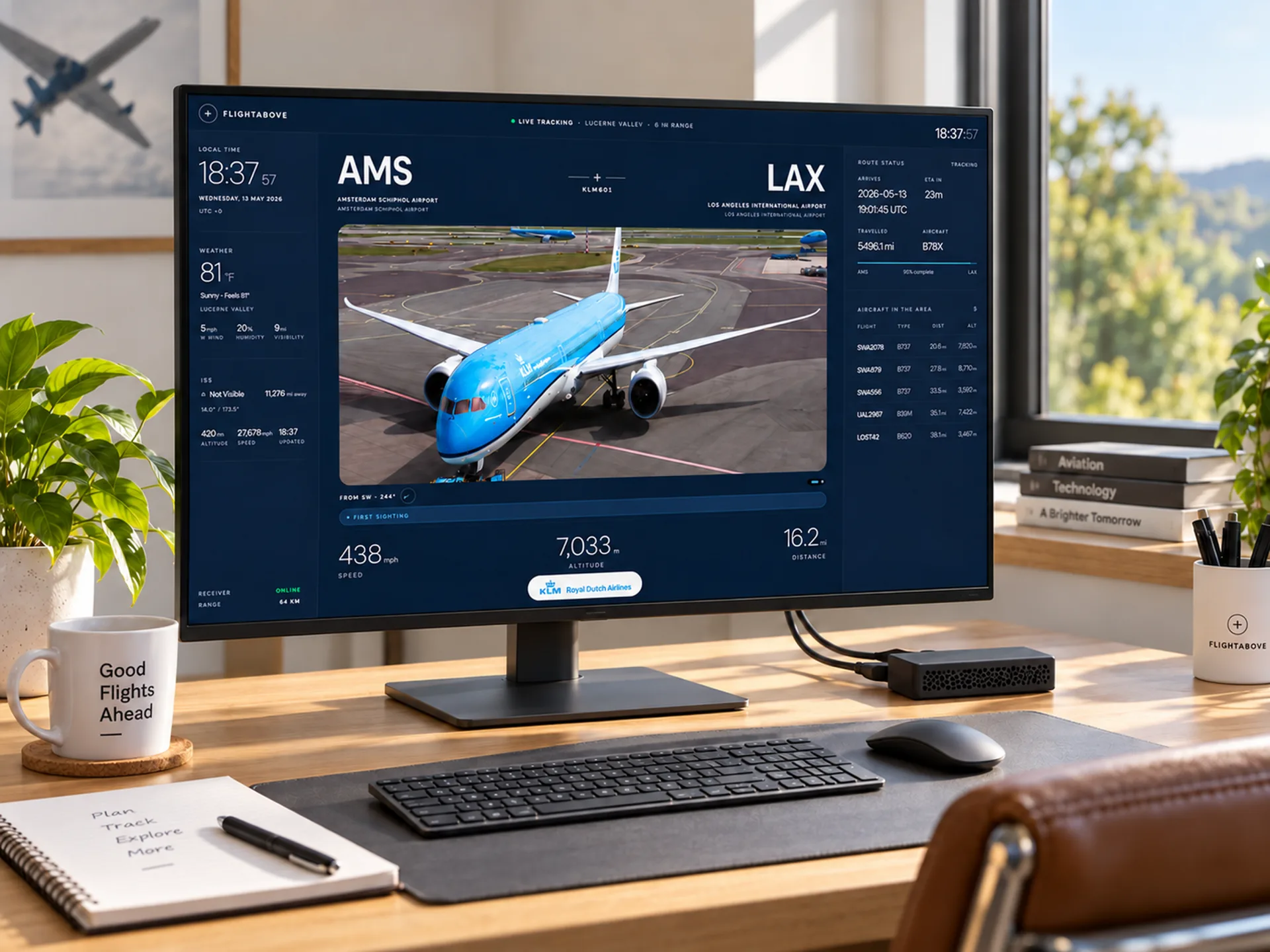
If the goal is the name of the plane going over, not the radio project, you do not need any of that. A display that reads the shared picture is plug in and go: join the Wi-Fi, set your location, and it shows the aircraft near you.
Plenty of people do both. They feed a network from the loft, and keep a display on the desk so they can glance at what their antenna is hearing without opening a laptop.
No antenna needed
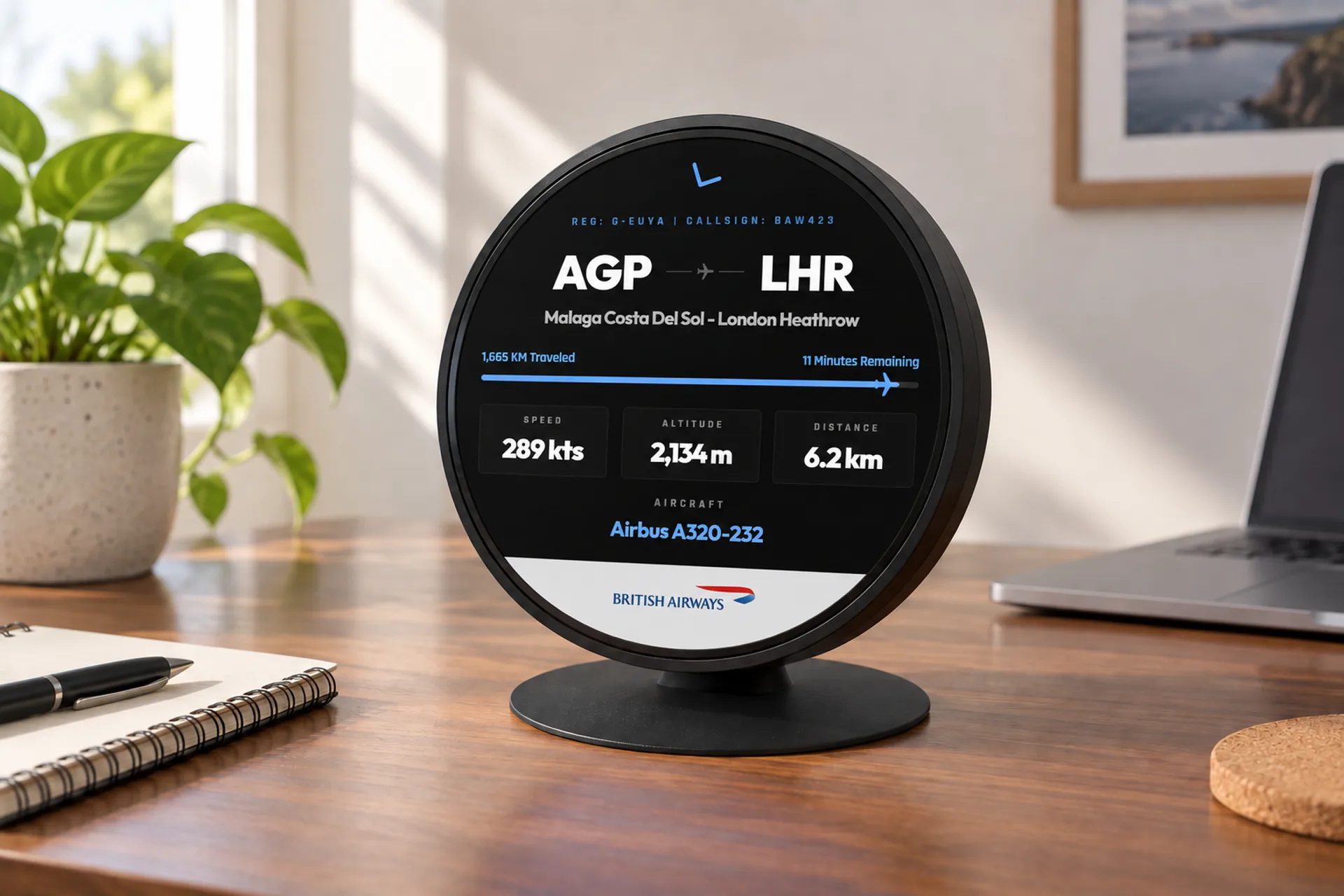
FlightAbove reads the shared tracking picture over Wi-Fi and shows the aircraft near you: the flight, the type, a photo, the route and the height. There is nothing to aim and nothing to tune.
Connect is the one for people who like Raspberry Pis: it is a Pi 4 that runs FlightAbove on a TV or monitor you already own, and it takes a mouse. Mini, Altitude and Horizon are all-in-one displays for the desk.
Hardware from £99.00, paid once, made in the UK
Quick answers
No. Thousands of receivers already share what they hear with tracking networks, and sites, apps and FlightAbove displays read that picture over the internet. A receiver of your own is optional.
No. It reads live tracking data over Wi-Fi. There is nothing to aim, tune or mount.
Usually a Raspberry Pi, a USB software-defined radio stick made for 1090 MHz, a 1090 MHz antenna mounted as high as you can, and free decoder and feeder software.
With a good antenna outside and high up, airliners 150 to 250 miles away. Indoors it is much less. Low aircraft nearby are the hardest to catch.
If you feed a community network that FlightAbove reads from, such as adsb.fi or adsb.lol, your receiver adds to the picture it uses, especially for low aircraft near you.
Airliners worldwide use 1090 MHz. 978 MHz, called UAT, is used by some light aircraft in the United States only. In the UK, 1090 MHz is the one that matters.
How aircraft tracking works· FlightAbove Connect· Why planes disappear over the sea· How high do planes fly?
No antenna, no setup
The flight, the type, a photo and the height of the aircraft over your house. A clock when the sky is quiet. Paid once, made in the UK.