
7500
Unlawful interference
The crew is telling controllers the aircraft is under threat, including a hijack. It is rare, and it is taken with absolute seriousness.
Emergency codes
Squawk 7700 is the general emergency code. A pilot sets it on the transponder so every controller in range knows the flight needs priority. It is the catch-all: a technical problem, someone unwell on board, or anything else that is not a hijack and not a failed radio.
It shows up on flight trackers because the code rides along with the aircraft's position. Most 7700s end in a diversion and a safe landing. Seeing one is a reason to pay attention, not a reason to assume the worst.
The broadcast
Every transponder-equipped aircraft broadcasts a four-digit code. The pilot sets it. Air traffic control assigns it. On a controller's screen, that code is how one aircraft is told apart from the others in the same piece of sky.
Most codes are ordinary and local. Three of them are reserved everywhere and mean the same thing in every country. Those are the ones people look up after they see a number flash on a tracker. How aircraft tracking works explains the rest of the broadcast those sites are reading.
Reserved worldwide
Crews sometimes remember them as a short set: 7500 for unlawful interference, 7600 for a radio that will not work, 7700 for every other emergency. The order is the useful part. The rhyme some people use is just a way to keep that order in mind.
7500
The crew is telling controllers the aircraft is under threat, including a hijack. It is rare, and it is taken with absolute seriousness.
7600
The crew cannot talk to air traffic control. The aircraft can still fly, and there is a published way to continue without the radio.
7700
Everything else that needs priority. A technical problem, a passenger who is unwell, a fuel concern. The code crews reach for when they want the sky cleared around them.
In practice
Usually less frightening than the tracker makes it look. Setting 7700 gives the flight priority and room in the airspace, so crews are encouraged to use it early rather than wait until a problem gets worse.
The familiar causes are a medical emergency, a technical snag, a pressurisation problem, or fuel. A large share of them finish as a normal diversion and an uneventful landing. Passengers sometimes never hear that anything was declared. A pilot who sets 7700 for a passenger with chest pain has done the careful thing.
7500 is the one that is grave. 7600 is a communications problem with a known procedure behind it. 7700 is the wide gate, which is why it is the code you are most likely to see, and the one most often misunderstood.
Why it spreads
Position and the squawk code leave the aircraft in the same broadcast. Any site reading that broadcast can highlight 7700, and a social post can follow within seconds. An event that once stayed between the flight deck and the controller is now a worldwide notification.
That changes how often it feels like it happens. You are not suddenly living under more emergencies. You are seeing ones that used to be invisible, including flights nowhere near your house. A phone app is built to zoom out to all of them. A desk display is built for the sky you can actually hear.
The numbers
The code is transmitted in octal. Octal has eight symbols, 0 through 7, and no 8 or 9. Four of those digits make 4,096 combinations. Regions hand them out for local traffic. The emergency trio sits outside that day-to-day pool, reserved so they never get assigned to an ordinary flight.
| Code | Meaning | How to read it |
|---|---|---|
| 7500 | Unlawful interference | Rare. Treated as a threat to the aircraft. |
| 7600 | Radio failure | Uncommon. The flight continues without voice contact. |
| 7700 | General emergency | The one trackers surface. Often less grave than it looks. |
| 7000 | VFR, UK and much of Europe | Not an emergency. The ordinary code when none has been assigned. |
| 1200 | VFR, United States | Not an emergency. The ordinary American VFR code. |
On the desk
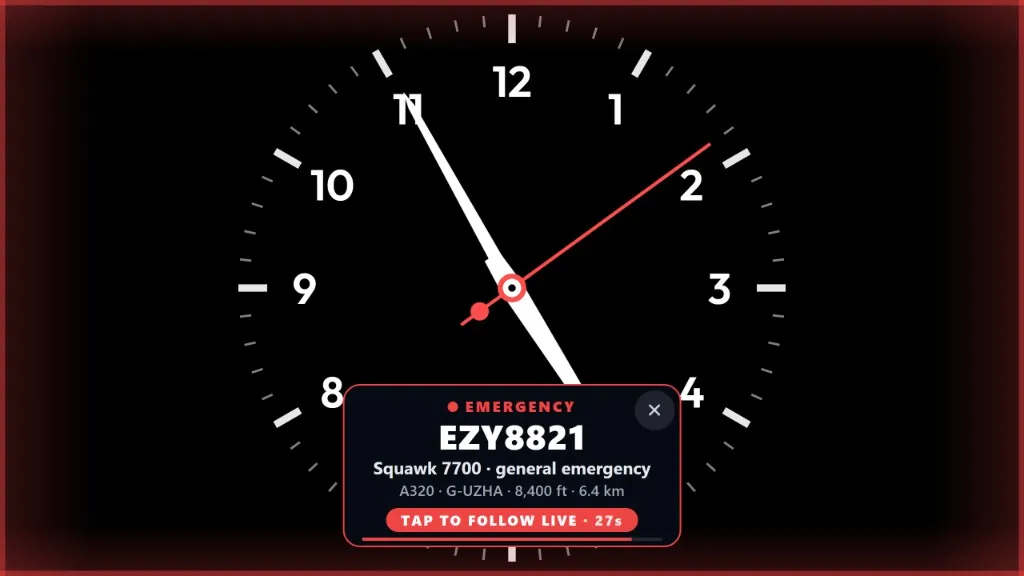
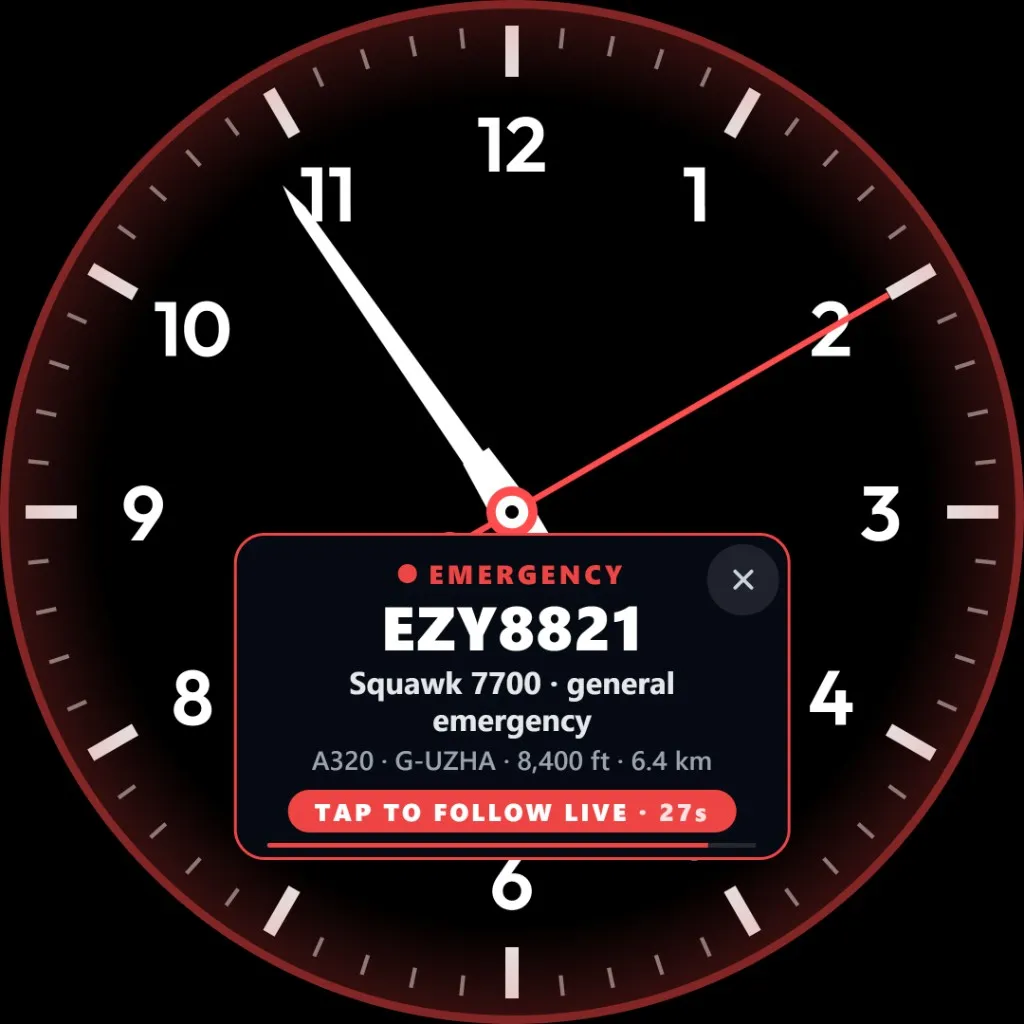
The same transponder broadcast that feeds a tracker can light a display in the room. FlightAbove puts the code on a red card and says what it means, then waits until that squawk has been seen twice in a row. One garbled read does not light the room.
You choose the reach. Emergency squawks can stay inside your own range, or you can hear about them anywhere. Emergency services are a different alert, in teal, for police, air ambulance and coastguard nearby. Those stay local. A 7700 and an air ambulance are not the same card.
This is for people who watch aircraft. It is not a distress service, and it does not call anyone for you. The full set of alerts, including military and a watchlist, is on live flight alerts. Reported 7500, 7600 and 7700 codes, with a photo and a place, are listed on recent squawk alerts.
Hardware from £99.00, paid once, produced in the United Kingdom
Quick answers
Squawk 7700 is the general emergency code. A pilot sets it on the transponder so controllers know the flight needs priority. It covers a technical problem, a medical issue on board, or anything else that is not a hijack or a radio failure.
7500 means unlawful interference, including a hijack. 7600 means the crew cannot talk to air traffic control on the radio. 7700 is the general emergency. All three mean the same thing in every country.
No. Crews are encouraged to set it early, so 7700 is often a medical problem, a minor technical fault, or a fuel concern. Many end in a normal diversion and a safe landing. Setting it early is careful flying, not panic.
7700 means the flight needs priority for a general emergency. 7600 means the radios have failed and the aircraft is otherwise able to continue under the published radio-failure procedure. 7600 is not a request for the same kind of help as 7700.
7500 means unlawful interference. The crew is telling controllers the aircraft is under threat. It is rare, and it is treated with absolute seriousness.
A squawk is sent in octal, which has no 8 or 9. Four digits from 0 to 7 give 4,096 possible codes. Controllers assign most of them. A few are reserved worldwide.
The code travels in the same transponder broadcast as the aircraft position, so a public tracker can see it. What used to stay with the crew and the controller is now visible as it happens, which makes emergencies feel more common than they are.
They are not emergencies. In the UK and much of Europe, 7000 is the ordinary VFR code when no discrete code has been given. In the United States, 1200 is the ordinary VFR code. Both are very common.
The screen edge lights red and a card names the code and what it means. FlightAbove waits until the squawk is seen twice in a row, so one bad read does not light the room. You can keep emergency squawks inside your range, or hear about them anywhere. This is for people who watch aircraft. It is not a distress service.
What are planes overhead? · Compare the displays · Flight tracker display · Aviation gift guide
When one is near you
7700, 7600 and 7500, in words, after the squawk has been seen twice. Produced in the United Kingdom. Hardware paid once.